Mythology and threat

In a recent issue of The London Review of Books (22 September 2022), Mary Wellesley describes the changing faces of Lilith over the centuries. Lilith is the poster image for the British Museum’s current Feminine Power Exhibition. Lilith, she explains, is a figure from Mesopotamian and Jewish demonology.

In early sources she was thought to kill babies, and to seduce and murder adults. In some traditions she was responsible for miscarriage, infertility and illegitimate births. One incantation, spiralling around a ceramic bowl on display reads: ‘evil Lilith who leads astray the heart of humans beings’ and appears in ‘a dream of the night … slaying boys and girls [and] sucklings, male and female ’ to be ‘subdued and sealed, [away] from the house’.  Jewish tradition, from around the late first millennium understood Lilith to be the first wife of Adam, created by God from the same clay, unlike  Eve who was created later from a spare rib. ‘Adam insisted’ she writes, ‘that Lilith lie beneath him during sexual intercourse as an admission of her inferiority. She refused and fled Paradise.’ Following Adam’s complaints, God sent three angels to fetch her back. She refused, and according to mediaeval tradition, made her home in the Red Sea, where she gave birth to demons and was believed to be a threat to pregnant women.

Lilith’s reputation as a witch and sorceress, a raider demoness, has followed her through the centuries. A 13thcentury Spanish treatise describes her as the wife of the demon archangel Samuel, the pair forming a demonic counterpart to Adam and Eve. In the 19th century she appears in Goethe’s Faust as a temptress, with Mephistopheles encouraging Faust to dance with her.  The Pre-Raphaelites transformed her to an auburn-headed beauty, the witch Adam loved before the gift of Eve, the tantalising ‘other woman’. In the 1970s, with the rise of the Women’s Liberation Movement, Lilith was adopted as a feminist icon, the strong female presence that refuses to be subjugated to the demands of men.

‘This complex, changing image,’ writes Mary Wellesley, ranges ‘from Mesopotamian and Jewish demon, bringer of miscarriage and sterility, to rebellious wife of Adam, to Victorian hottie and feminist icon.’ 

Such transmogrifications.  Yet through it all one thing prevails – Lilith, the female figure who defies subjugation to men, remains, always, a threat, a threat to the power of men, to the stability of the patriarchy.

Adam didn’t have much luck with his second choice of helpmate given him by God either. Submissive she may have been, willing to lie beneath him in the paradisiacal Garden of Eden, but it was the beautiful Eve who enticed her partner to partake with her of the forbidden fruit in spite of God’s warning, which led to expulsion from the Garden and the loss of innocence for mankind. The concept of original sin was born, all due to woman. More bad press for womankind, even the submissive variety, with their clever, wily ways. Still a threat to the power of men. 

As I sit here, in my eighth decade on this earth, and ponder on the changes that have been made in the lives of women in liberal democracies like Australia – and they have been considerable – I am also very aware that the idea of women as a threat, the echoes of the mythological Lilith, and the disobedient Eve, are with us still. 

How else to explain the vicious and degrading attacks on Australia’s first female prime minister, Julia Gillard, from prominent media personalities and the then leader of the opposition? A woman daring to challenge all the stereotypes of the ideal woman to serve the patriarchy.

How else to explain the sense of male entitlement we have witnessed recently in the halls of Australia’s Federal Parliament? Or the current struggle of Iranian women to walk freely in the streets of their country dressed as they choose? Or the countless women suffering domestic violence when they fail to meet the expectations of their male counterparts? 

Sexism, like racism, is so deeply rooted in the human mythology and psyche. It seeps in unwanted when least expected, it infects our relationships often without us being aware of it. The older I get the more complicated everything becomes it seems. 
Myanmar – a tragedy of the highest order

Several weeks ago a message arrived from my friend S, a Chin resident  of the town of Kalaymyo. ‘Our situation is so terrible, more terrible than you heard about,’ she wrote. ‘We are so worried about our Country and Covid. Sometimes we do not know how to live.’

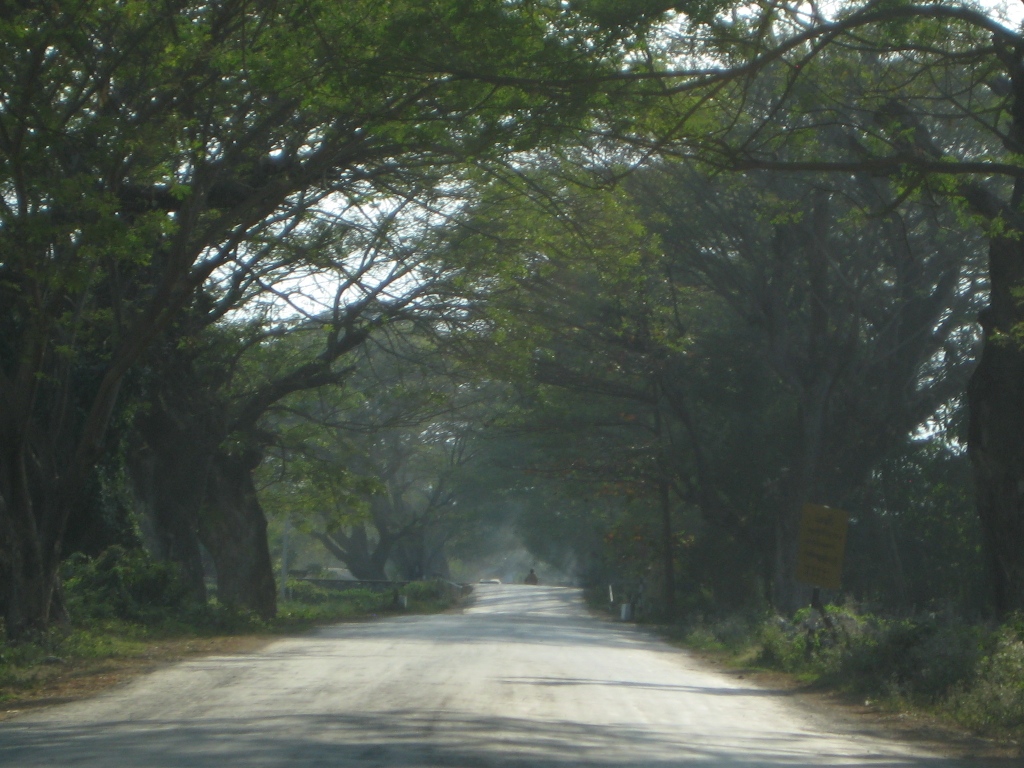
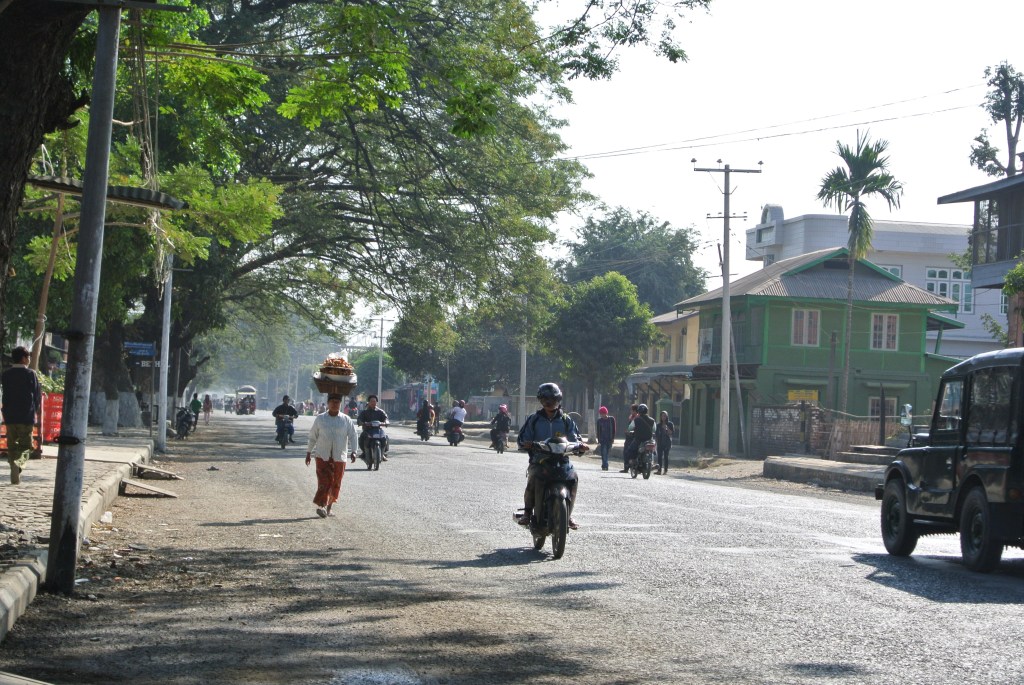
Kalaymyo sits at the base of the Chin Hills on the edge of Saigang Division, in the west of Myanmar. It is a completely flat and dusty town, a main street running its full length parallel to its small airport runway. The Myittha River, a tributary of the mighty Chindwin River, waters its field crops, and at times floods the whole area. The town is divided in two: the eastern side is populated by the Bamar people with their Buddhist temples and a huge market: the western side, called Tahan, by the Chin people who have come to settle there from the mountains of Chin State and built their plethora of Christian churches among their homes. They have their own market too. 

Kalaymyo and surrounds 2014

In 2011, my first visit to Myanmar, the cruel, astrology-loving President, Than Shwe stepped aside and made way for one of his generals, Thein Sein, to become Chairman of the State Peace and Development Council (a misnomer if ever there was one). In March 2011 Thein Sein became the 8th President of Myanmar. My friend, P, who was born in Chin State, but moved to Mizoram across the Indian border to the west after the 1988 uprising, (he had been a student at Yangon University at the time and heavily involved) told me that Thein Sein was a friend to the Chin People. He had been the General in charge of the army – the violent Tatmadaw – in the Kalaymyo area, and during his time there conditions for the Chin improved. Shortly after he was installed as President, Thein Sein visited Kalaymyo and insisted that electricity should be supplied throughout Tahan as it already was in the Bamar part of the town. A hopeful sign. Change was in the air. A quasi democracy was beginning to emerge.

When I visited Myanmar in 2014 the overbearing army presence was no longer evident in the slow streets of Kalaymyo. I arrived a week after Aung San Suu Kyi had visited the town. She was by then a member of Parliament. Her recent presence was palpable.  She had chosen to stay at the same modest hotel in Tahan where I stayed. ‘There’, the manager said with such pride, pointing to the empty first floor front balcony with its concrete barrier. ‘Daw Suu spoke to the people from there.’ Later I watched a video at a local pastor’s house of the huge gathering at the sports arena, where thousands of people from all around the district had gathered eight days before to hear her speak about the need for constitutional change to give a fair go to the ethnic states in the union, and to ask them to support her National League for Democracy party in the 2015 elections. 

My last visit to Kalaymyo was in 2018. Change had come and Kalyamyo was settled and comfortable, far from the machinations of the Pyithu Hluttaw politicians in Naypyidaw, the opulent capital of Myanmar. Many Chin people had returned to their villages in Chin State from Mizoram, India, where they had sought safety and a better life free from poverty and threat from the Tatmadaw presence. General services had improved, the Kalay civil hospital now had treatments available for range of illnesses including AIDS, overseas aid could now be transferred relatively easily as banking systems and technology access improved. 

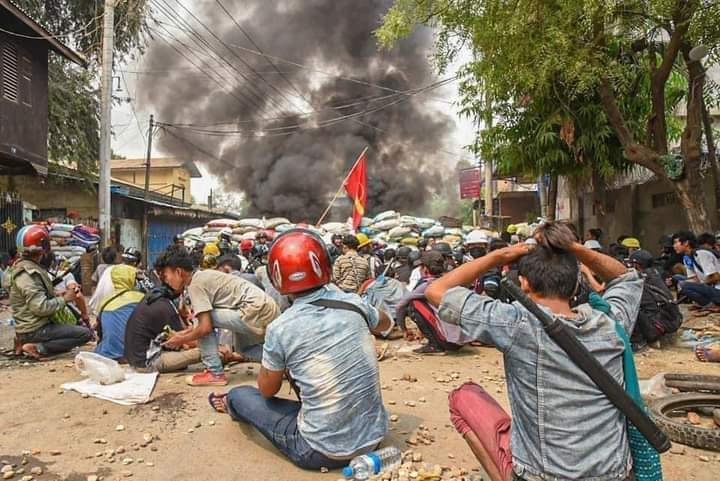
Kalaymyo became one of the first instances of armed resistance to the Tatmadaw following the military coup in February 2021. Protesters, often armed only with hunting rifles, set up strongholds in the town, and organised ambushes on soldiers and policemen coming into the town. The military response has been brutal. The resistance and killing continues today. 

Kalaymyo today – a battleground

On July 25 the military junta executed four pro-democracy  activists, the first executions in more than 30 years. They had been held in the notorious Insein Prison in Yangon, among the hundreds  incarcerated since the coup. One of them, Kyaw Min Yu, known widely as Ko Jimmy, had been, like my friend P, a student leader of the 1988 uprising. So many years of struggle with the scent of change so close. The Assistance Association of Political Prisoners says that 113 others have also been sentenced to death, 41 of whom were convicted in absentia. The organisation claims that 14,883 people have been arrested and 2,123 have been killed by the military forces since February 2021.

Sitting at my  desk in Adelaide, overlooking my green winter garden, it is impossible to imagine those once quiet dusty streets of Kalaymyo, where the midday rush had consisted of a cavalcade of bicycles and motorbikes overladen with families and parcels weaving in and out of the occasional car and fume-belching truck heading for the Chin Hills, now filled with armed conflict and death; or the anguish of a mother with a dying child struggling to breath due to Covid unable to take her to the civil hospital because of the military enforced curfew. Myanmar – a tragedy of the highest order.

Through my window I can see the crows make their circuitous flight home to the enormous old eucalypts two blocks away. They have been foraging in my garden for material for their nest. And I ponder on my despair over the past few years at what seemed to be the manipulable flaws in our Australian democratic processes, and I watch the damage that so quickly can be done to a country as powerful as the US when ideology and falsehood become the order of the day. How precious our democracy is, how fragile, and how easy it is to take it for granted. 

Rich and poor

I have been clearing up the odds and ends I place for later on top of the printer on my desk. A bad habit, this tearing out of bits and pieces from newspapers, collecting bits of information from wherever I might visit, things that I mean to use for some purpose at another later time. At times I get fed up with it all, rapidly go through the mess, and turf the lot. After all, it is usually past news I have never done anything with. But here I am with a snippet from, who knows, probably The Adelaide Advertiser, dreadful paper that it is. I had neglected to note on it where I had sourced it from, or when. It is one column, ten centimetres maybe, probably from the World News page which The Advertiser now puts right at the back of everything local or of Oz national. ‘Tax the rich to save the poor’ its small font headline announces. It is a report on the last World Economic Forum held as usual in Davos, in May 2022, after having been postponed for some years because of Covid. 

As background, the WEF touts itself as the international organisation for public-private cooperation, engaging the foremost political, business, cultural and other leaders of society to shape global, regional and industry leaders. ‘We believe,’ their website says, ‘that progress happens by bringing together people from all walks of life who have the drive and the influence to make positive change.’ Davos is located in the Swiss alps and gained prominence in the 19th century as a mountain health resort. Today it is the home of one of Switzerland’s largest ski resorts. An unlikely location as a source for a statement like ‘Tax the rich to save the poor,’ given the number of billionaires and millionaires who congregate regularly on WEF matters. A true global elite.

In keeping with the ‘all walks of life’ claim of the Forum, Gabriela Bucher, Oxfam director, was in attendance. She noted that 263 million people are expected to sink into extreme poverty this year, at a rate of one million every 33 hours, given soaring inflation and the effect of Covid worldwide.  In stark contrast, 573 people became billionaires during the pandemic, that is one every 30 hours. ‘Billionaires,’ she said, ‘are arriving in Davos to celebrate an incredible surge in their fortunes. … Meanwhile, decades of progress on extreme poverty are now in reverse and millions of people are facing impossible rises in the cost of simply staying alive.’

Hence the call from Oxfam for a one-off ‘solidarity tax’ on billionaires’ pandemic windfall to go some way to assisting people facing increasing poverty and help fund a ‘fair and sustainable recovery from Covid.’

A wealth tax, a mining tax, a fairer progressive tax system – tax reform in other words. And I think of the people who right now, in this coldest of Adelaide winters for many years, sleeping in their cars, or on the street corner, homeless, unable to find or afford rental accommodation, women fleeing from domestic violence often with children … the list goes on. And those of us lucky enough to have warm beds and a roof over our heads continue to cavil at the idea of paying more tax to enable the state to increase its services, fund agencies that can assist individuals in need, to enable a reset which would make it possible to live in more equitable communities. Tax reform shows itself to be, again and again, a death knell for governments dependent on big business and voter support. What does it take to bring about real change which would see us live in a fairer world?

Why a blog?

My friend Elizabeth, who has a long-established blog, Stories of Buttons and Bread, to which she contributes each weekend, has been trying to persuade me to start my own blog. I have always resisted, at the same time as I regularly check in to read her weekly pieces. They always make me think about the centrality of the small details of daily life that she so beautifully describes, the courage and value and beauty in simply being alive, putting one foot in front of the other, and getting on with this daily business of living. ‘No,’ I always remonstrate, ‘the regular writings in my notebooks over the years are personal, they are my way of making it possible for me to understand me and my ordinary journey.’ And that is quite true, except that they served another purpose in another time of my life.

Late last year I finally became a widow. It shouldn’t have been a surprise, but of course it was. Death always is when it finally comes about. My partner of more than fifty years, was diagnosed with multiple sclerosis when we were in our early thirties. The disease progressed very slowly, largely I believe because of his own determination to grab as much life as he possibly could for as long as he possibly could. I still think of him as ‘greedy for life’. They were hard years together, with dramatic ups and just as dramatic downs. But we were bonded together through shared values, a love of travel and adventure, and two children who really only ever knew their dad as a bloke with MS. My endless notebooks became the place where I explored my feelings about it all, and my feelings and ideas about the world around me. It was also a place where I could privately vent my despair, my fury at the problems we were always beset with, none of which I could ever discuss with him, in denial to the end. Denial, I must add, is a great survival mechanism, albeit very damaging to those around you when finally the obvious becomes impossible to deny.

But now, as the dust settles, and the awful last years of total and, for him degrading dependency slip further back into the long memories of our shared life, I realise that my writing was more than that, that in fact it was very much part of the continuum of our daily lives, it was part of the fodder for our constant conversation about the world outside us. And now those conversations, the place where you can say and explore anything safely, is no more. In truth, I had a good apprenticeship to its disappearance. Over the last few years, his fear of losing his independence and his focus on himself and his survival began to erode what we had taken for granted for so long. There was no room for the rest of us and our needs in his struggle for a physical life that was slipping inexorably from him.

Having gone through the obligatory funereal goodbye to a partner, a lover, a father, a colleague, a cobber, a teacher, an old soak and, in better days, a bon vivant, I now realise that these latter bad times have been put back in the place where they belong and it really is possible to see our fifty-something year journey together for what is was – a marvellous sharing of ideas and learning from each other, constant travels, great sex, a haphazard attempt to build a family, times of furious arguments, coping together with losing the idealism of youth … and underpinning it all a constant struggle to achieve a balance given our origins in the fiercely patriarchal society we grew up in.

But the conversations still continue in my head and the scribbles in my notebooks appear as usual. Maybe sharing them may be of use to someone, somewhere.